 UHF Fiber Optic Repeater
TS7C00A/TS7B20A


400-470 MHz UHF Fiber Optic Repeater
UHF Fiber Optic Repeater




描述
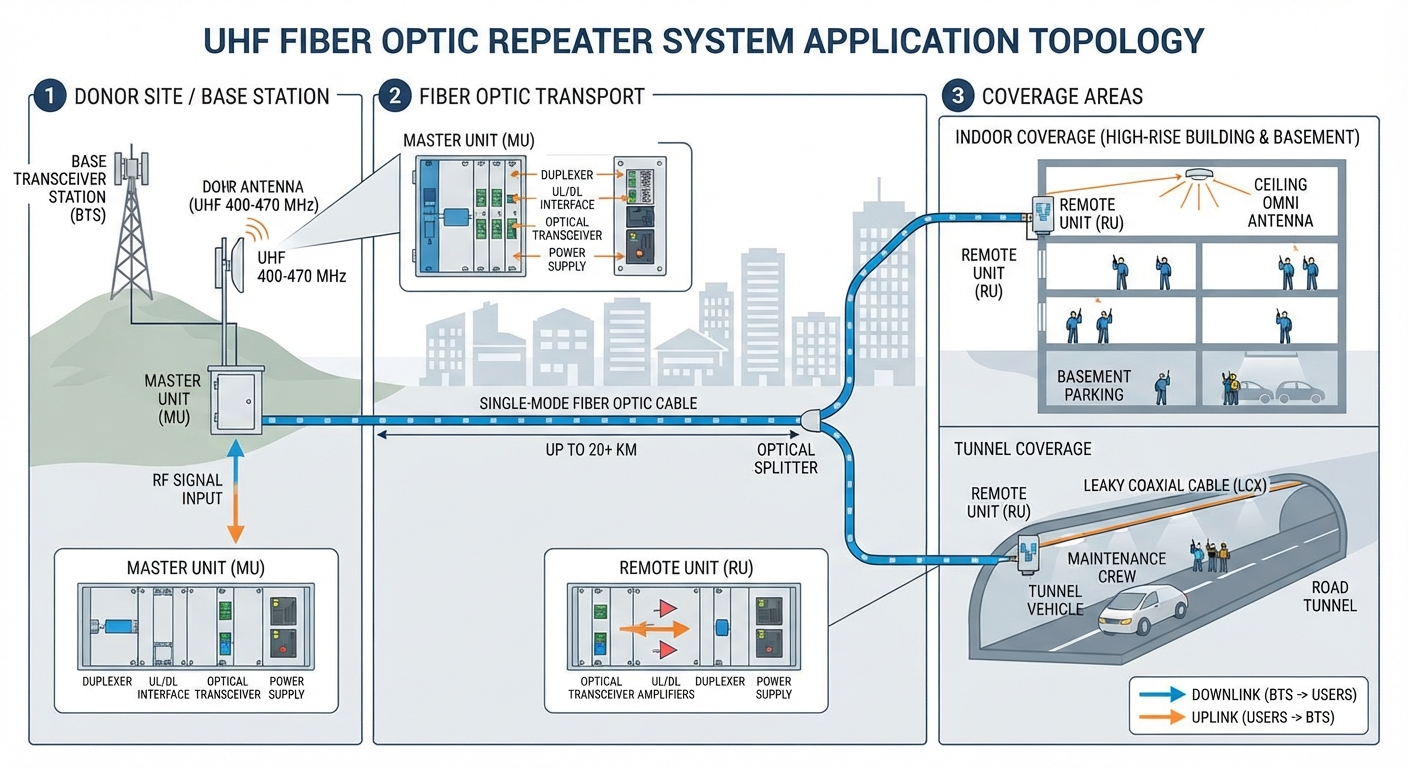
UHF Fiber Optic Repeater is an active distributed antenna system designed to extend wireless communication coverage. It is primarily used to resolve UHF (Ultra High Frequency, typically between 380-512 MHz) signal blind spots or weak reception issues in large buildings, underground tunnels, mining areas, or regions far from the Base Transceiver Station (BTS). By utilizing fiber optic cables for long-distance, low-loss signal transmission, it is particularly suitable for public safety systems (such as TETRA, P25), enterprise private networks (DMR/PMR), and two-way radio signal extensions.
System Components & Working Principle
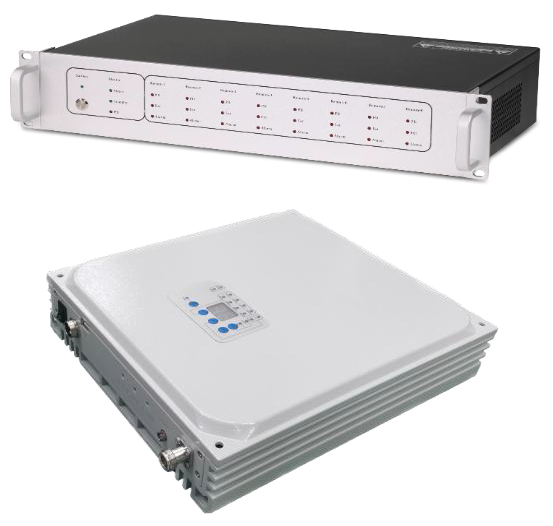
A UHF fiber optic repeater system typically adopts a two-layer architecture, consisting of the following two core units:
Master Unit / Donor Unit (MU):
l Installed near the Base Transceiver Station (BTS) or at a location capable of receiving a strong wireless signal.
l Captures the RF (Radio Frequency) signal from the base station via a direct coupler or a donor antenna.
l Converts the internal RF signal into an optical signal and transmits it over long distances through a single-mode fiber optic network.
Remote Unit / Coverage Unit (RU):
l Deployed in the target blind zones requiring signal coverage (e.g., inside tunnels, basements).
l Receives the optical signal from the fiber optic cable and converts it back into an RF signal.
l Amplifies the signal using an internal power amplifier and broadcasts it through indoor/outdoor coverage antennas to terminal devices (such as walkie-talkies or radios).
l Conversely, the uplink signal from terminal devices travels back along the reverse path to the base station.